
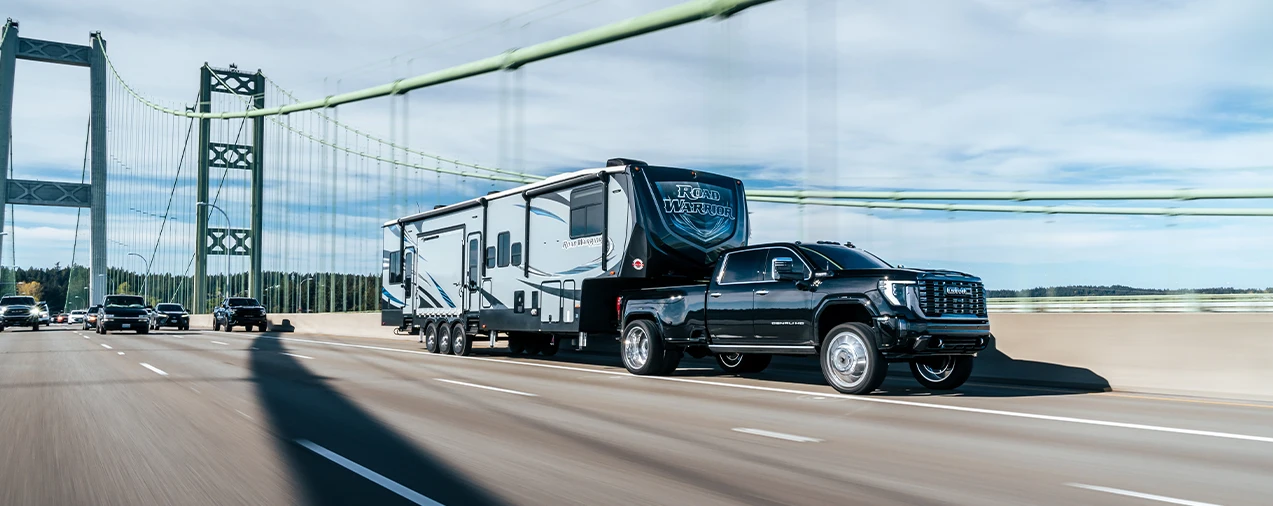
The complete guide to matching your tow vehicle with the right RV—without the guesswork or scary surprises on your first trip.
Why Towing Capacity Matters
Picture this: You've found the perfect travel trailer. Great floor plan, fits the budget, and the dealer says it's "half-ton towable." You sign the papers, hitch up, and pull onto the highway—only to feel your truck squatting, swaying in crosswinds, and struggling to stop at every exit ramp.
This scenario happens more often than you'd think. The RV looked perfect on the lot, but nobody ran the actual numbers. Now you're stuck with a trailer your vehicle can't safely handle.
Exceeding your vehicle's towing capacity isn't just uncomfortable—it creates real problems:
The good news? Matching your vehicle to the right RV is straightforward once you understand a few key numbers. Let's start with the terminology.
Key RV & Towing Weights Explained
RV weight specs can feel like alphabet soup. Here's what each term actually means—in plain English.
What it is: The maximum safe weight of your RV (or tow vehicle) when fully loaded—including water, propane, cargo, and passengers.
Why it matters: This is the hard ceiling. Exceed it and you risk brake failure, tire blowouts, and frame damage. Your RV's GVWR determines what class of tow vehicle you need.
What it is: The maximum allowable weight of your tow vehicle plus the trailer plus everything inside both.
Why it matters: This is your complete system limit. Even if your truck can tow 10,000 lbs, your GCWR might cap the combined weight before you hit that number.
What it is: The number from your vehicle manufacturer stating the maximum trailer weight your vehicle can pull.
Why it matters: This is the headline number most people shop by—but it often requires specific equipment packages (axle ratio, engine, cooling) to achieve. Always verify your exact configuration.
What it is: The maximum weight your tow vehicle can carry in and on itself—passengers, cargo, tongue weight from the trailer, and anything in the bed.
Why it matters: This is where many setups fail. Your payload must handle the tongue weight plus passengers plus anything in the truck. Check the yellow sticker on your driver's door jamb for your specific vehicle's payload.
Dry Weight: What the RV weighs fresh from the factory—no water, propane, cargo, or options. This is the number dealers love to advertise because it's the smallest.
GVWR: The maximum the RV can weigh when loaded. This is what you should shop by.
CCC (Cargo Carrying Capacity): GVWR minus dry weight. This tells you how much stuff you can actually put in the RV before hitting the limit.
Dry Weight: 5,200 lbs
GVWR: 7,500 lbs
CCC: 2,300 lbs (for water, propane, clothes, food, gear, etc.)
What it is: The downward force the trailer puts on your tow vehicle's hitch ball. For travel trailers, this should be 10-15% of the total trailer weight.
Why it matters:
- Too light (under 10%): The trailer becomes tail-heavy and sways dangerously.
- Too heavy (over 15%): Your truck squats in the rear, steering gets light, and you overload your rear axle.
- Just right (10-15%): The trailer tracks straight and your truck stays level.
This weight counts against your payload capacity—don't forget to include it.
The 80% Rule: A Simple Safety Margin
Here's the simplest advice we can give: keep your loaded RV weight around 80% of your vehicle's maximum tow rating.
Why leave that buffer? Because manufacturer ratings assume ideal conditions—flat roads, no wind, moderate temperatures, and minimal passengers or cargo in the tow vehicle. Real camping trips look different:
- Mountain passes add strain even going uphill
- Crosswinds and passing semis test your control
- Hot weather taxes your cooling system and transmission
- Four passengers plus luggage can eat 600+ lbs of payload
- A full fresh water tank adds another 400+ lbs
The 80% rule keeps you in the comfortable zone where your vehicle works with you instead of against you.
of max tow rating
Example: If your truck is rated for 10,000 lbs, aim for an RV with a GVWR of 8,000 lbs or less.
Quick Method: Will My Vehicle Tow This RV?
Before you fall in love with a floor plan, run through these three steps. It takes five minutes and can save you from an expensive mistake.
Find these three numbers for your specific vehicle:
- Max Tow Rating
- Payload Capacity
- GCWR
Where to look:
- Owner's manual
- Door jamb sticker (payload)
- Manufacturer's tow guide (search "[year] [make] [model] towing guide")
Dealers often advertise dry weight because it's lighter. Don't fall for it.
Once you add water, propane, food, clothes, camping gear, bikes, and that camp grill you won't leave behind—your trailer will be much closer to its GVWR than its dry weight.
Multiply your max tow rating by 0.80. That's your target GVWR ceiling for comfortable towing.
× 0.80 = 8,000 lbs
Target RV GVWR: 8,000 lbs or less
Also verify: tongue weight fits within payload, and combined weight stays under GCWR.
Want to run the exact numbers?
Use the MintRV Towing CalculatorEnter your vehicle specs and any RV to see if it's a safe match.
Typical Towing Capacity Ranges by Vehicle Type
Not sure what category your vehicle falls into? Here's a general breakdown of towing capacity by vehicle type—and what RVs typically match each.
SUVs & Crossovers
Most crossovers and midsize SUVs are comfortable in the 1,500–3,500 lb range. Larger body-on-frame SUVs (Tahoe, Expedition, 4Runner) can reach 5,000–8,000+ lbs properly equipped.
Good RV matches: Pop-up campers, teardrops, small/lightweight travel trailers under 20 feet
Midsize Trucks (Tacoma, Ranger, Colorado, Frontier, etc.)
Midsize trucks offer a sweet spot between maneuverability and towing capability. With the right tow package, many can handle mid-weight travel trailers comfortably.
Good RV matches: Small to mid-size travel trailers (18-26 feet), lightweight toy haulers, some smaller fifth wheels with properly equipped trucks
Half-Ton Pickups (F-150, Ram 1500, Silverado 1500, Tundra)
Half-ton trucks are the most popular tow vehicles for a reason. Most real-world configurations fall in the 7,000-11,000 lb range, with max-tow packages pushing into the low teens.
Good RV matches: Most "half-ton towable" travel trailers (24-32 feet), toy haulers, and some lighter fifth wheels designed for 1500-series trucks
Three-Quarter-Ton & One-Ton Trucks (F-250/350, Ram 2500/3500, Silverado 2500/3500)
Heavy-duty trucks are built for serious towing. Conventional towing ranges from 10,000-20,000+ lbs, with fifth-wheel and gooseneck setups reaching even higher.
Good RV matches: Large bunkhouse travel trailers, full-size fifth wheels, toy haulers, and anything marked "requires 3/4-ton or 1-ton truck"
| Vehicle Type | Typical Tow Range | MintRV Weight Class Match | Common RV Types |
|---|---|---|---|
| SUV/Crossover | 1,500 – 5,000 lbs | Ultra Light | Pop-ups, teardrops, small trailers |
| Midsize Truck | 3,500 – 7,500 lbs | Light | Small-mid travel trailers, light toy haulers |
| Half-Ton (1500) | 7,000 – 13,000 lbs | Light – Standard | Most travel trailers, some fifth wheels |
| 3/4-Ton (2500) | 10,000 – 17,000 lbs | Heavy | Large trailers, most fifth wheels |
| 1-Ton (3500) | 14,000 – 20,000+ lbs | Super Heavy | Large fifth wheels, heavy toy haulers |
Gear and Upgrades That Affect How an RV Tows
You'll hear about plenty of aftermarket products that promise better towing. Some genuinely help with stability and comfort—but none of them increase your vehicle's official tow rating. Let's clear up what each one actually does.
Weight Distribution Hitches (Leveling Hitches)
What they do: Redistribute tongue weight from your rear axle to all four wheels (truck and trailer), leveling out your setup and improving steering response.
What they don't do: Increase your vehicle's official tow or payload rating. They make the weight you're carrying feel better—not disappear.
When you need one: Most manufacturers recommend a weight distribution hitch for travel trailers over 5,000 lbs or when the trailer weighs more than 50% of your tow vehicle's weight.
Helps with: Steering, braking, headlight aim, rear squat
Sway Control Systems
What they do: Reduce trailer sway caused by crosswinds, passing trucks, or road irregularities. Available as friction bars (add-on) or integrated into weight distribution hitches.
How sway starts: When wind or road forces push the trailer sideways and it overcorrects, creating a "tail wagging the dog" effect that can become uncontrollable.
Still required: Proper tongue weight (10-15%) and balanced cargo loading. Sway control is a safety net—not a fix for a poorly balanced setup.
Helps with: Crosswinds, passing semis, driver confidence
Trailer Brake Controllers
What they do: Activate your trailer's electric brakes in sync with your tow vehicle, dramatically reducing stopping distances and wear on your truck's brakes.
Types:
- Time-delayed: Applies trailer brakes on a preset ramp. Simple and affordable.
- Proportional: Matches trailer braking force to how hard you press the pedal. Smoother and more responsive.
When you need one: Most trailers over 2,000-3,000 lbs have electric brakes—you need a controller to use them. Many newer trucks include one from the factory.
Helps with: Stopping distance, brake wear, emergency stops
Suspension Helpers (Airbags, Timbrens, Helper Springs)
What they do: Add support to your rear suspension, reducing squat, improving ride quality, and keeping your truck level under heavy tongue weight.
What they don't do: Legally increase your tow or payload ratings. The numbers on your door jamb don't change.
Good use cases: Carrying heavy tongue weight while staying within limits, improving ride quality, reducing bottoming out on bumps.
Helps with: Rear squat, ride quality, level stance
Tires and Load Ratings
Why it matters: Your tires are the only thing connecting your setup to the road. Under-rated tires can be a weak link even if everything else checks out on paper.
LT vs P-metric: Light Truck (LT) tires typically have higher load ratings than passenger (P-metric) tires. Most serious towing setups need LT tires.
Load range: Check the load index on your tire sidewall. It must equal or exceed your share of the load on each axle.
Often overlooked weak point in towing setups
Common RV Towing Mistakes (and How to Avoid Them)
We see the same mistakes repeated over and over. Avoid these and you're already ahead of most first-time RV buyers.
Shopping the RV before checking tow ratings
Falling in love with a floor plan, then trying to make the numbers work.
Fix: Know your vehicle's ratings before you ever step on a dealer lot.
Using dry weight instead of GVWR
The dealer says it weighs 5,000 lbs—but that's empty weight, not real-world loaded weight.
Fix: Always shop by GVWR. Assume your trailer will travel near that number.
Ignoring payload and tongue weight
Focusing only on max tow rating and forgetting that payload must handle tongue weight plus passengers.
Fix: Check your door jamb sticker. Subtract passengers and gear, then see what's left for tongue weight.
Assuming "tow package" means maximum rating
Factory tow packages help, but max ratings often require specific engines, axle ratios, and cooling options.
Fix: Look up your exact configuration in the manufacturer's tow guide.
Relying on someone else's setup
"My buddy tows a 32-footer with his F-150, you'll be fine."
Fix: Your buddy's truck might have a different engine, axle ratio, or just be over his limits. Run your own numbers.
Thinking upgrades fix everything
"I'll just add airbags and a weight distribution hitch—then I can tow anything."
Fix: Upgrades improve comfort and stability, but they don't change your legal weight limits.
Frequently Asked Questions About RV Towing Capacity
Technically, you can tow up to 100% of your rated capacity—but you probably shouldn't. We recommend staying around 80% for comfortable, safe towing in real-world conditions (hills, wind, heat, loaded truck).
Towing at or near your maximum every time accelerates wear on your transmission, brakes, and suspension. The closer you are to the limit, the less margin you have for unexpected situations.
It's not a legal requirement—it's a practical guideline. Manufacturer ratings are tested in controlled conditions. Real camping involves mountain passes, headwinds, 100-degree days, and four passengers with luggage.
The 80% buffer gives you room for all of that while keeping your tow vehicle working comfortably rather than at its absolute limit.
Some fifth wheels are specifically designed for half-ton trucks—often called "half-ton towable" or "light fifth wheels." These typically have GVWRs in the 10,000-12,000 lb range and pin weights around 1,500-2,000 lbs.
The catch: Payload capacity is usually the limiting factor, not towing capacity. Fifth wheels put more weight on your truck (pin weight vs tongue weight), and half-tons often have payload limits of 1,500-2,200 lbs. After passengers and cargo, you may not have enough left for the pin weight.
Always verify both your tow rating AND payload capacity before committing to a fifth wheel.
No. Weight distribution hitches, airbags, helper springs, and similar upgrades improve how your vehicle handles the weight—but they don't change your manufacturer's official tow or payload ratings.
Think of it this way: these products make a legal load feel better. They don't make an illegal load legal.
Always use GVWR. Dry weight is what the RV weighs empty from the factory. Once you add water (8.3 lbs/gallon), propane, food, clothes, camping gear, and personal items, you'll be much closer to the GVWR.
Most RVers find their loaded trailer weighs 85-95% of GVWR on a typical trip. Shopping by dry weight sets you up for a nasty surprise at the scale.
Towing capacity: How much weight your vehicle can pull behind it.
Payload capacity: How much weight your vehicle can carry inside and on it—including passengers, cargo, and tongue weight from the trailer.
Both limits matter, and you must stay within both. Many towing setups fail on payload before they fail on towing capacity.
Check these sources for your specific vehicle configuration:
- Owner's manual: Lists towing specs for your model
- Door jamb sticker: Shows your specific payload capacity
- Manufacturer's tow guide: Search "[year] [make] towing guide" for a detailed PDF with all configurations
Don't rely on general specs—engine, axle ratio, cab style, and packages all affect your actual ratings.
Next Step: Check Your Vehicle and RV Combo
Now you know the numbers to look for and the mistakes to avoid. The final step is running your specific vehicle and RV through the calculations to confirm you've got a safe, comfortable match.
Don't guess—verify. A few minutes with the calculator now can save you from discovering a mismatch on the highway.
Last Updated: December 2024
This guide is part of MintRV's RV Buying Guides series. We maintain our database of over 70,000 RV specifications to help you make informed decisions based on real data—not dealer sales pitches.
Found this helpful?
Try the Towing Calculator